Showing posts with label USMC. Show all posts

Saturday, November 28, 2009

Dead General Quote of the Week

Bold Predictions

After leading the successful but costly invasion of Tarawa, General Holland M. "Howlin' Mad" Smith would find himself commanding at another bloody stop on the island hopping campaign. Waiting off the coast of Iwo Jima in February, 1945, Navy commanders asked Smith to appraise how his men would fare on the island:

This will be the bloodiest fight in Marine Corps history. We'll catch seven kinds of hell on the beaches, and that will be just the beginning. The fighting will be fierce, and the casualties will be awful, but my Marines will take the damned island.


Monday, November 23, 2009

November 23, 1943

Blood on the Coral: Or the Most Expensive Square Mile in the Pacific.

We start the new week at Lies Agreed Upon with one of the more infamous battles in the Pacific Theater of World War II. The tiny atoll of Tarawa, in the Gilbert Island chain nearly 2,400 miles southwest of Pearl Harbor, was seen by American commanders as a vital step in the island hopping campaign across the Central Pacific. Planners had their sights set on the Marianas Islands, another 2,000 miles further west, to establish the airbases needed to take the war to the Japanese home islands. Standing in the way was the heavily armed garrison on Tarawa's Betio Island, a spit of rock with an area less than a square mile.

Landing troops on a hostile shore, protecting them while they unload equipment and then keeping them supplied is often considered the most difficult operation a force can attempt. These challenges were compounded at Tarawa for several reasons. First, the beaches of the island are only accessible from the shallow lagoon the atoll surrounds. Approaching from the sea is impossible. Furthermore, the tides around the Gilberts are notoriously fickle, and at times hide jagged coral reefs that can rip the bottoms right out of landing craft.

Marines storm an enemy pillbox on Tarawa.

In addition, Tarawa was occupied by 5,000 men of a special naval detachment, essentially Japanese marines. These elite troops spent over a year creating an interwoven web of trenches, bunkers and pillboxes. The difficult task of assaulting Tarawa fell to the men of the 2nd Marine Division. During the inter-war period, the United States Marine Corps had pioneered the art of amphibious landings on beaches all over the Caribbean. The few offensive landings undertaken since the start of the war had not been contested on the beaches by the Japanese. The landings on Tarawa in late November, however, would put the Americans to the ultimate test.

The first wave of Marines was met at the water's edge by heavy machine gun and mortar fire. They would be forced to fight their way onto the island, but they were ashore and organizing at the base of a seawall on the beach. As the second wave approached, the predicted tides failed to change and landing craft had to dump their men and equipment nearly a hundred yards out to sea. Men laden with nearly half their body weight in gear were forced to wade through chest-high water under fire. By the time the third wave arrived, the distance was nearly five times that. The first wave was hit hard; the second decimated; the third nearly destroyed.

The problems did not end once the Marines got off the beach. The well planned defensive network proved its worth over the course of the next three days, exacting a bitter price for each yard the Americans advanced. Nevertheless, the typical marine bravado was evident throughout the battle. During the fighting, a report by Colonel David. M. Shoup, who would eventually become the Commandant of the Marine Corps, summed up both the combat and the attitude of the Marines: "Casualites: many; Percentage of dead: not known; Combat efficiency: we are winning."


Colonel David M. Shoup, shown here with his trademark cigar, won the Medal of Honor for his actions on Tarawa.


By November 23, 1943, through incredible bravery, overwhelming firepower and sheer grit, the Marines had cleared the island. Afterward, for one of the first times ever, the American public was allowed access to the gruesome details of the savage war in the Pacific. The "butcher's bill" at Tarawa would be shocking, as in just three days of fighting casualties in many units topped 50 percent. Up to that point, it was the costliest battle in the history of the Marine Corps. A short documentary, With the Marines at Tarawa, was released the next year, and Americans found themselves aghast at the deadly carnage their sons faced on a daily basis. Of the 5,000 Japanese on the island, only about 150 were taken alive.

After the battle, the huge casualty numbers caused many to question not only the necessity of the fight, but the conduct of the war as a whole. Marine General "Howlin' Mad" Holland Smith later wrote "Was Tarawa worth it? My answer: an unqualified No." Smith blamed the casualties on poor planning and a lack of understanding of tides in the Gilberts. He felt Tarawa could have been bypassed and the Japanese defenders left to "wither on the vine." Nevertheless, the Marines proved that any island could be taken by an amphibious assault, regardless of the number of defenders or the extent of their fortifications. The lessons learned at Tarawa would prove invaluable on the long road to Tokyo.

This grisly scene was repeated all along the shores of Tarawa in late November, 1943. It was the first time the Japanese had contested an American landing at the water's edge.

Friday, June 26, 2009

June 26, 1918

A Note on Frontal Assaults: Or Germany's Rude Introduction to the United States Marine.


The calendar could not be more cooperative in the first week of this blog's existence, as it has allowed us to cover three of our favorite things: cold Germans; over-zealous Frenchmen; and now, the U.S. Marine Corps.

After America entered the First World War in April of 1917, the country was caught in the same patriotic fervor that had gripped European nations in the late summer and fall of 1914. Clearly, report after report of the horrific carnage and waste in the trenches of the Western Front had done nothing to dissuade American boys from thinking a great adventure awaited "Over There."

That first April, hundreds of thousands of Americans volunteered for the armed forces, and they were quickly joined by the millions of draftees Uncle Sam needed to back up his promise to defend democracy. By year's end, French ports were teeming with American supplies and cocky young Yanks itching for a fight. Alone in this group of army citizen-soldiers was a brigade of United States Marines, professional fighters seasoned from their role as Teddy Roosevelt's "Big Stick" in Central America.

When revolution forced Russia out of the war, the Germans were able to free up huge numbers of men and equipment to redeploy to the Western Front. In the spring of 1918 they used these resources to launch an offensive aimed at destroying the Allies before the untried Americans could be put into battle. It almost worked, as they penetrated further than they had since the first days of the war, but were halted just 40 miles from Paris after American units saw their first combat.

The Germans then turned to try and flank the capital, and on June 1, 1918 entered Belleau Wood, a forest occupied by French troops. Just arriving to the front and filling in the line to the right of their ally, the Marines saw French forces fleeing from their positions. Told that the situation was hopeless and to turn back, Captain Lloyd W. Williams uttered the famous words "Retreat? Hell, we just got here." Aren't Marines fun?

The Marines, soldiers of the U.S. Army's 9th Infantry and the French stopped the attack, but then had to enter the woods themselves to clear out the remaining Germans. To do this, they attempted the same frontal assaults on fixed positions that had failed so miserably at places like Verdun, Ypres, and even Gettysburg the century before. Even with the wholesale slaughter seen up and down the Western Front, tactics had still not evolved enough to avoid so costly a sacrifice. The Marines entered the woods shoulder to shoulder, bayonets fixed, and were mowed down by German machine guns.

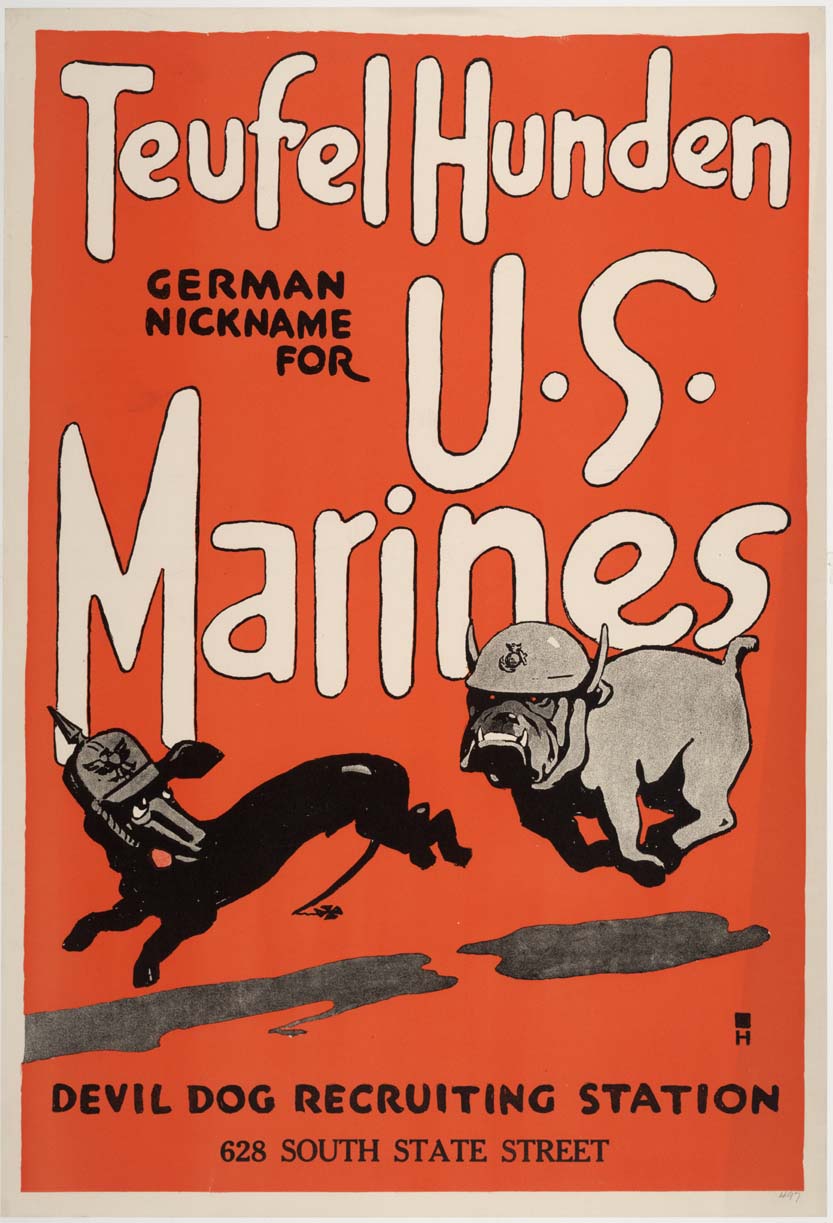
Yet as usual, the individual valor of the Marine was not absent during these bloody assaults. Under fire, out-numbered and out-gunned, two-time Medal of Honor recipient Sergeant Dan Daly led his men in an attack with the stirring cry "Come on you sons of bitches, do you want to live forever?" Shocked at the ferocity of their fighting and impressed by their professional attitude, the enemy was said to distinguish Marines from army units with the nick-name "Teufelhunden," a crude German translation of "Devil Dogs."


On June 26, 1918, after nearly a month of fighting throughout the woods, the Marines and French soldiers finally cleared out the last of German resistance. With the German spring offensive finally snuffed out, the momentum shifted to the Allies, who soon began their own offensive into the German line. So depleted by their last gasp attempt at winning the war, and faced with the prospect of fighting millions of fresh American troops, the Germans were near the end. Nevertheless, the suicidal frontal assaults and bloody fighting continued for another four months.

The final exclamation point on the Battle of Belleau Wood was a sparse report dispatched to American headquarters after the forest was cleared. Brief and to the point, qualities every Marine values, the report summed up the battle simply and humbly: "Woods now U.S. Marine Corps entirely."