Showing posts with label OZFOTD. Show all posts

Monday, November 30, 2009

December 1, 1826

Feta and Brie: Or A Chaud Time in the Old Town Tonight.

We start off the chilly month of December with a hot battle in the history of Athens, one of the world's oldest cities. After the Byzantine Empire fell to the Turks in the 15th Century, much of the old Eastern Roman Empire, including all of Greece, fell under Ottoman control. Three centuries of Islamic rule began in the ancient land, but not without obvious resentment from the native Greeks. While the Turks were enamored with the antiquated beauty of Athens, the city's population had less than cordial feelings toward their new rulers.

Despite the fact that Turkish forces were ordered to leave the ancient ruins of Athens in peace, most inhabitants had fled the city by the start of the 19th Century. In the coming years, constant conflict with the west meant many of the city's buildings, even on the famed Acropolis, were turned into fortresses, and the Turks went as far as burning most of the city to stop a Venetian attack in 1688. By 1814, a secret society of Greek patriots known as the Filiki Eteria, or "Society of Friends", felt it was time to restore the nation to its rightful owners.

For the most part, Europe was unsure of how to view the Greek nationalists. While any swipe at the Ottomans was seen as beneficial, western rulers were nervous that uprisings against an established empire could incite similar movements at home. Some Europeans, however, knew exactly where they stood. Enter our honorary over-zealous Frenchman of the day, Charles Nicolas Fabvier. As you might imagine, Fabvier had very different ideas about European involvement in Greece.


Charles Nicolas Fabvier, in traditional Greek dress.


A well-schooled engineer and expert in all types of cannon, he once served as an artillery major under the indomitable Michel Ney. After joining the army in 1804 Fabvier was wounded in several major engagements during the Napoleonic wars. He was the representative from France who signed the peace treaty after Bonaparte was exiled the first time, then reenlisted and followed his emperor to Waterloo. In 1823, Fabvier was under investigation by the French government for aiding Bonapartists when he decided to join the Greek Independence movement.

After rebuilding the coastal fortifications in Navarino Bay, on the western coast of Greece, Fabvier was given command of the newly formed Greek Army. His men made their way to Athens, which had briefly been held by the Greeks before being retaken by the Ottomans, to lay siege to the Turkish forces occupying the Acropolis. There, on December 1, 1826, Fabvier's men succeeded in breaking through enemy lines and seizing the ancient monument to Western Civilization.

Unfortunately for the Greeks, and for Fabvier's legacy, the capture of the Acropolis was not the end of the war. Two more years of fighting and more than three more years of negotiations still lay ahead for the troubled crossroads between east and west. Following his battle in Athens, Fabvier returned to France to drum up further support for Greek independence. He made his way back to Greece to participate in the final battles of the war in 1828.

Following the War of Independence, King Othon of Greece makes his way to the foot of the Parthenon on the Acropolis after entering Athens in 1833.

Perhaps because he was a foreigner, Fabvier does not get the same credit as other heroes of the Greek War of Independence, most notably Alexander Ypsilantis and Theodoros Kolokotronis. In spite of this, his contributions cannot be overlooked. A soldier through and through, Fabvier was eventually promoted to Lieutenant General by the French government and later served in parliament. In keeping with our goals at Lies Agreed Upon, we felt the tale of this fighting Frenchie was too good to pass up.

Tuesday, November 17, 2009

November 17, 1812

Le Rougeaud: Or a Frenchman So Bad Even Napoleon Had to Tip His Cap.


Back in June, Lies Agreed Upon covered similar events on consecutive days because the calender was chock-full of topics too good to pass up. Now, however, we return to Napoleon's invasion of Russia, simply because it appears November 17 is a slow day in military history. Therefore, today we will look at the Battle of Krasnoi, in which the Russians tried to pounce on the remnants of the Grand Armee as it made its desperate attempt to flea enemy territory.

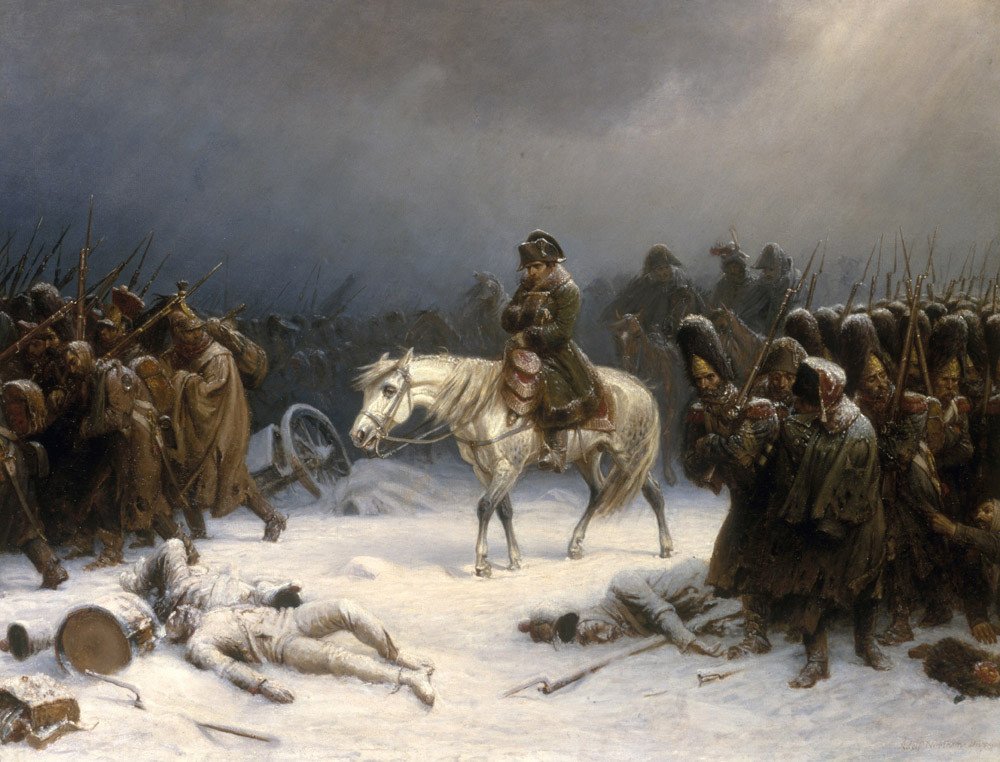
After abandoning Moscow in October, Napoleon was determined to move what was left of his army to its supply base at Smolensk, nearly 270 miles to the west. The Russians, aided by their old ally, General Winter, harassed the French the entire way. So depleted were Napoleon's forces by the time they reached their objective that Bonaparte decided he could no longer hold the position. He hoped to reach Orsha, a supply base further west, then planned on making winter camp near his huge depot at Minsk.

Assuming his enemy was just as hampered by the weather as his own troops, Napoleon decided to move his men out as quickly as possible. Instead of concentrating his army, he sent it out piece-meal, corps by corps on the road to Orsha. Napoleon himself, personally commanding a unit of veterans known as the Imperial Guard, planned to wait for the rear units of the army at a small town called Krasnoi, now known as Krasny near the modern day border with Belarus. It was here, with the battered Grand Armee staggering into town piece by piece, that the Russians struck on November 17, 1812.

The battle itself is not overly significant, with the Russians lashing at the heels of a battered enemy that, while unable to offer much resistance, was retiring in good order. A strong feint by the Imperial Guard gave most of the army enough time to move through the city and continue toward Orsha. The approach of the Russian army, however, meant that French units could not wait for their rear guard to catch up as originally planned. Any remaining men in the tail end of Napoleon's army would be forced to fight their way through enemy lines to rejoin their comrades.

Luckily, the rear guard was commanded by Michel Ney, Napoleon's close friend and one of his original Marshals of the Empire. As is our practice here at Lies Agreed Upon, we must take a moment to recognize Ney, our honorary over-zealous Frenchman of the day. Serving since 1787, Ney was the extremely seasoned leader of the army's III Corps, and earned the dubious honor of commanding the rear guard.


Marshal of France
Michel Ney
.


Ney had fought under Napoleon since the Emperor's first days in command and continuously proved his worth. Affectionately dubbed Le Rougeaud, or Red Face, by his men, not even a neck wound suffered a few months before the retreat was enough to keep him from duty. Arriving at Krasnoi late on November 17, Ney was surprised to find the Russians, not his comrades, waiting for him. Undeterred, and convinced the remnants of the Grand Armee were nearby, Ney ordered his exhausted Corps to attack the next morning.

They nearly succeeded. Three lines of Russian infantry lay before him, and Ney's veterans slashed, shot and gouged their way through the first two. The third line, however, refused to yield, and a swift counterattack nearly routed what was left of III Corps. Ney, cut off from his commander and left with only a few thousand men, fled into the forest. For the next few days they blindly marched to the west, constantly shadowed by the dreaded Russian Cossacks. Ney eventually reunited with Napoleon near Orsha on November 20, a feat so impressive even the egotistical Bonaparte dubbed him Le Brave des Braves, "The Bravest of the Brave."

Ney cemented himself a place in military history for his relentless drive toward Krasnoi. Twice during the battle, first when he came in sight of the Russian lines and then again after the counterattack scattered his forces, the enemy offered Ney a chance to honorably surrender. Both times, he refused. He served under Napoleon all the way to Waterloo three years later, a battle that saw five horses shot from under him.

After Napoleon was exiled Ney was arrested and tried for treason. Despite a huge public outcry for one of France's heroes, he was convicted and sentenced to death, perhaps to set an example for Bonaparte's other followers. Before the firing squad, he refused the customary blindfold and gave the order to fire himself, with these stirring final words:
Soldiers, when I give the command to fire, fire straight at my heart. Wait for the order. It will be my last to you. I protest against my condemnation. I have fought a hundred battles for France, and none against her. Soldiers...Fire!
It sounds like Napoleon knew bravery when he saw it.

Wednesday, June 24, 2009

June 24, 1812

A Note on General Winter: Or How We Cover Napoleon, Sun Tzu, and Hitler in a Single Bound.


Although we covered an invasion of Russia just two days ago (and quite a similar one at that), this gives us a chance to look at the comparable invasions of Adolph Hitler and Napoleon Bonaparte. Plus, we will never pass up a chance to give the Little Dictator some press. He did name this blog, after all.


At the height of the Napoleonic Wars, Bonaparte had a strong hold on most of continental Europe. The defeat at Trafalgar in 1805 proved he lacked the naval power to invade the the British isles, but he beat back a Russo-Austrian invasion in the East a few years later. Just as Hitler would over a century later, Napoleon sought to destroy his biggest enemy on the mainland. On June 24, 1812, his Grand Armee, 690,000 strong and composed in large part of foreign conscripts, crossed the Nieman River and set off to Moscow. When they returned six months later, they numbered just 22,000.


Both the 1812 (Patriotic War if you're a Tsarist) and 1941 (Great Patriotic War if you're a Soviet) invasions failed, stymied by the size of Russia's territory and the sacrifices of her sons. For five more quick reasons why, we can go to our old friend Sun Tzu, whose Art of War never fails to prove itself as the authority on warfare.

Sun Tzu wrote "the art of war is governed by five constant factors":


(1) The Moral Law
(2) Heaven
(3) Earth
(4) The Commander
(5 )Method and Discipline


For fun, lets see how Dolph and Nap match up against ol' Mother Russia.

(1) The Moral Law- Sun Tzu describes this as identifying with which side the morality lies. Which side, if any, has a more just cause for fighting. Defending themselves from invasions attempting to wipe them off the map, in both cases surely the first point goes to the Russians.
(2) Heaven (And we don't mean God)- When Sun Tzu wrote "Heaven" he meant time, weather and seasons, not Jesus, Allah and the Flying Spaghetti Monster. Notice these invasions were launched just two days apart on the calender. At least Hitler and Napoleon were mindful of this, jumping off at the start of summer. But costly battles and logistical nightmares kept them from prevailing before Russia was saved by her greatest ally: General Winter. Russia up 2-0-0.
(3) Earth- Location, Location, Location. By earth, Sun Tzu meant the very land on which the battles are fought. Russia is impossibly large, and any plans to invade it are impossibly ambitious. Two armies, both at the time of invasion the largest in the world to that point, failed to conquer all that territory. Furthermore, had they succeeded, maintaining a presence in that area for any period of time would be a more than herculean effort. Russia still pitching a shutout as we go to the top of the fourth.
(4) The Commander- This one speaks for itself. There is definitely something to be said for conquering most of Europe, as both Hitler and Napoleon did. However, they both suffered from, among other things, over-ambition, the same strategic flaw. And if a commander is supposed to extend some of his own virtues into his army, surely the virtues of these two men were not desirable ones to inherit. Hitler loses the point for his martial ignorance. Napoleon was a much better military mind, but if you're a commander and you decide to invade Russia, you lose this point automatically. 4-0-0.
(5) Method and Discipline- Napoleon himself said an army marches on its stomach, and Sun Tzu's methods and disciplines revolved mostly around logistics and supply. As mentioned, maintaining armies across the vast Russian steppe, even in high summer, is a daunting task. Combined with these first four points, even in mildest winter an invasion of Russia is just a no-win.

So, it was worth looking at the 1812 invasion of Russia, even if we just did Barbarossa. The similarities between the two campaigns are remarkable, then add in the lofty personalities involved and this is too good to ignore. Plus, 6th Century BC Sun Tzu still relates to military history in the 19th and 20th Centuries. Any time we get Sun Tzu in here, we've done our job.