Showing posts with label Russia. Show all posts

Monday, November 30, 2009

November 30, 1939

A Bad Dress Rehearsal: Or is the Enemy of My Enemy My Friend?

Today we start the new week and end the month of November with one of those small, sometimes forgotten dances that opened up the waltz of the Second World War. By 1945, Anglo-American troops had linked up with the Soviet Red Army, cutting Germany in half and linking the great Allies of east and west. History remembers these two forces combining to rid the world of the Third Reich, but some neglect that at the start of hostilities, the two sides almost became enemies.

Before the first German blitzkriegs were launched across Poland, Nazi and Soviet leaders had signed a mutual non-aggression pact that freed the two distrusting states of the immediate fear of a conflict with each other. This allowed both sides to pursue engagements elsewhere, even though each viewed the other as their main threat. While Hitler turned his eyes to the Western Allies that had shamed Germany after World War I, Stalin sought to reclaim Soviet territory lost to Finland during the Bolshevik Revolution a generation before.

His prime concern was with the city of Leningrad, in the extreme western reaches of the new communist empire. Stalin felt the namesake of his mentor could only be properly defended by reacquiring the lost territory. Also, while the Soviets and Finns had a non-aggression pact of their own, Stalin had noticed that almost none of the rapidly growing Finnish foreign commerce was coming across the border to the Soviet Union. Citing the potential conflict with Germany, he demanded that neutral Finland cede former Russian territory back to its rightful owner. The Finns flatly refused.

In late November, 1939, the Soviets claimed some of their troops had been shelled by Finnish forces near the border town of Mainila. When the Finns suggested the two countries investigate the incident, the Soviets feigned outrage and renounced the peace treaty between the two nations. On November 30, 1939, Red Army troops stormed across the border and Soviet planes bombed Helsinki, the Finnish capital. The short but ill-fated Winter War had begun.

Finnish ski troops man a trench during the brief but intense Winter War. While the Finns' clothing camouflaged them in the snow, many Red Army units began the war without cold weather gear.

Stalin, in all his paranoid wisdom, had quite successfully rid the Red Army of almost all its most experienced officers during the Great Purge the year before. Nevertheless, he felt his enormous army could easily beat back the outnumbered Finns and reclaim the territory he sought. The fact that Stalin was launching his invasion at the start of the Finnish winter and his men were attacking an enemy defending its homeland seemed lost on the dictator. As usual the lives of Red Army troops would foot the bill for Stalin's dreams of conquest.

The Soviets were woefully unprepared to fight such a campaign. With their best generals either dead or in Siberian gulags, the senior leadership in the Red Army was in shambles. Furthermore, the winter of 1939-40 was one of the coldest in Scandinavian records. All that, combined with the relentless determination of Finland's sons meant the easy war envisioned by the Red Army was far from the reality. By the end of the four month conflict, nearly 400,000 Russians had become casualties.

The West, for its part, was just as shocked at Stalin as it had been at Hitler earlier in the decade. This time, however, they planned to stop a hungry dictator before he took too healthy a serving for his plate. Aid poured in from many western nations, including Nazi Germany. Russia was booted from the League of Nations, and thousands of foreign volunteers made their way to Finland. The French and British, hoping to simultaneously cut Hitler's access to Scandinavian iron ore and to keep the fighting far from home soil, both planned to send troops to aid the smaller nation's cause.

The dogged Finnish defenders, however, could not hold back the Russian steamroller indefinitely. By the time spring had broken, the Red Army had secured the land Stalin felt was necessary to defend Leningrad. A fragile peace was arranged, but the Soviets could not escape the double indemnity of being viewed as both the aggressors and militarily incompetent. The Winter War would usher in more wholesale changes to the Red Army command structure, not all of which would be completed by the time the Germans invaded in 1941.

Broken Russian bodies and equipment litter Raate Road, the only line of escape for Red Army units trapped deep in Finnish territory during the Winter War.

Despite its brevity, the Winter War had lasting effects on the newly begun Second World War. Finland would not forget Russia's transgressions, and joined with Hitler once Operation Barbarossa was launched. Tensions between the west and the Soviet Union would remain until the Germans made them allies out of necessity. The Red Army would eventually regain its footing to throw back the Nazi invaders and emerge as the West's menace during the Cold War. Nevertheless, its first preparations for the rapidly approaching war nearly ended in disaster.

Tuesday, November 17, 2009

November 17, 1812

Le Rougeaud: Or a Frenchman So Bad Even Napoleon Had to Tip His Cap.


Back in June, Lies Agreed Upon covered similar events on consecutive days because the calender was chock-full of topics too good to pass up. Now, however, we return to Napoleon's invasion of Russia, simply because it appears November 17 is a slow day in military history. Therefore, today we will look at the Battle of Krasnoi, in which the Russians tried to pounce on the remnants of the Grand Armee as it made its desperate attempt to flea enemy territory.

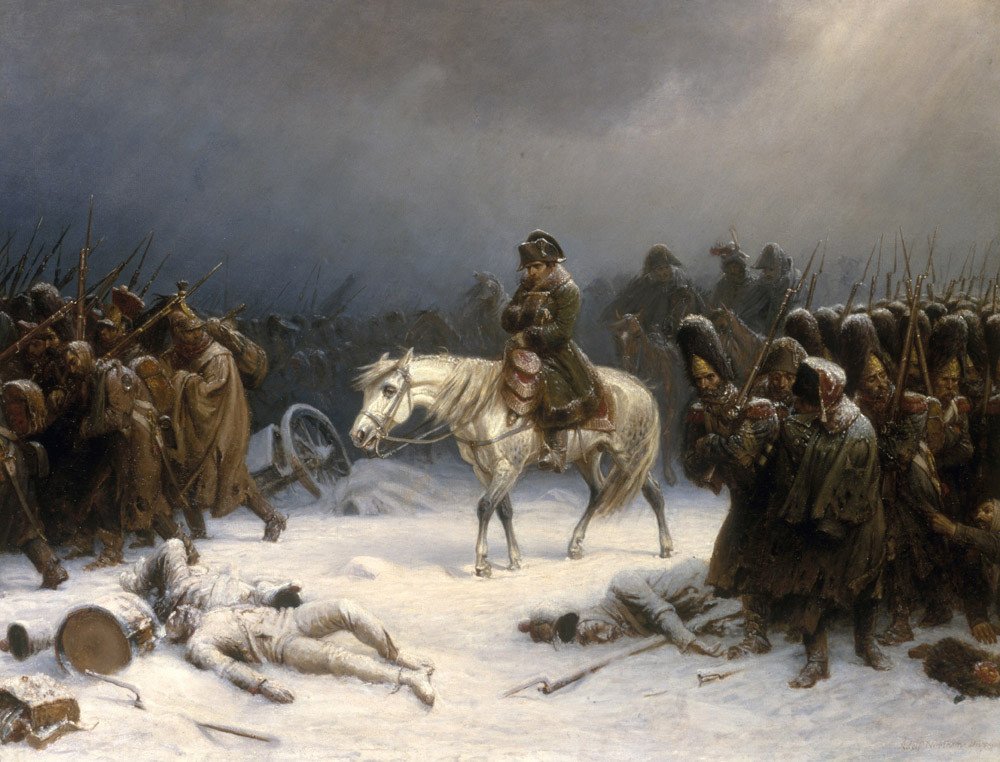
After abandoning Moscow in October, Napoleon was determined to move what was left of his army to its supply base at Smolensk, nearly 270 miles to the west. The Russians, aided by their old ally, General Winter, harassed the French the entire way. So depleted were Napoleon's forces by the time they reached their objective that Bonaparte decided he could no longer hold the position. He hoped to reach Orsha, a supply base further west, then planned on making winter camp near his huge depot at Minsk.

Assuming his enemy was just as hampered by the weather as his own troops, Napoleon decided to move his men out as quickly as possible. Instead of concentrating his army, he sent it out piece-meal, corps by corps on the road to Orsha. Napoleon himself, personally commanding a unit of veterans known as the Imperial Guard, planned to wait for the rear units of the army at a small town called Krasnoi, now known as Krasny near the modern day border with Belarus. It was here, with the battered Grand Armee staggering into town piece by piece, that the Russians struck on November 17, 1812.

The battle itself is not overly significant, with the Russians lashing at the heels of a battered enemy that, while unable to offer much resistance, was retiring in good order. A strong feint by the Imperial Guard gave most of the army enough time to move through the city and continue toward Orsha. The approach of the Russian army, however, meant that French units could not wait for their rear guard to catch up as originally planned. Any remaining men in the tail end of Napoleon's army would be forced to fight their way through enemy lines to rejoin their comrades.

Luckily, the rear guard was commanded by Michel Ney, Napoleon's close friend and one of his original Marshals of the Empire. As is our practice here at Lies Agreed Upon, we must take a moment to recognize Ney, our honorary over-zealous Frenchman of the day. Serving since 1787, Ney was the extremely seasoned leader of the army's III Corps, and earned the dubious honor of commanding the rear guard.


Marshal of France
Michel Ney
.


Ney had fought under Napoleon since the Emperor's first days in command and continuously proved his worth. Affectionately dubbed Le Rougeaud, or Red Face, by his men, not even a neck wound suffered a few months before the retreat was enough to keep him from duty. Arriving at Krasnoi late on November 17, Ney was surprised to find the Russians, not his comrades, waiting for him. Undeterred, and convinced the remnants of the Grand Armee were nearby, Ney ordered his exhausted Corps to attack the next morning.

They nearly succeeded. Three lines of Russian infantry lay before him, and Ney's veterans slashed, shot and gouged their way through the first two. The third line, however, refused to yield, and a swift counterattack nearly routed what was left of III Corps. Ney, cut off from his commander and left with only a few thousand men, fled into the forest. For the next few days they blindly marched to the west, constantly shadowed by the dreaded Russian Cossacks. Ney eventually reunited with Napoleon near Orsha on November 20, a feat so impressive even the egotistical Bonaparte dubbed him Le Brave des Braves, "The Bravest of the Brave."

Ney cemented himself a place in military history for his relentless drive toward Krasnoi. Twice during the battle, first when he came in sight of the Russian lines and then again after the counterattack scattered his forces, the enemy offered Ney a chance to honorably surrender. Both times, he refused. He served under Napoleon all the way to Waterloo three years later, a battle that saw five horses shot from under him.

After Napoleon was exiled Ney was arrested and tried for treason. Despite a huge public outcry for one of France's heroes, he was convicted and sentenced to death, perhaps to set an example for Bonaparte's other followers. Before the firing squad, he refused the customary blindfold and gave the order to fire himself, with these stirring final words:
Soldiers, when I give the command to fire, fire straight at my heart. Wait for the order. It will be my last to you. I protest against my condemnation. I have fought a hundred battles for France, and none against her. Soldiers...Fire!
It sounds like Napoleon knew bravery when he saw it.

Wednesday, June 24, 2009

June 24, 1812

A Note on General Winter: Or How We Cover Napoleon, Sun Tzu, and Hitler in a Single Bound.


Although we covered an invasion of Russia just two days ago (and quite a similar one at that), this gives us a chance to look at the comparable invasions of Adolph Hitler and Napoleon Bonaparte. Plus, we will never pass up a chance to give the Little Dictator some press. He did name this blog, after all.


At the height of the Napoleonic Wars, Bonaparte had a strong hold on most of continental Europe. The defeat at Trafalgar in 1805 proved he lacked the naval power to invade the the British isles, but he beat back a Russo-Austrian invasion in the East a few years later. Just as Hitler would over a century later, Napoleon sought to destroy his biggest enemy on the mainland. On June 24, 1812, his Grand Armee, 690,000 strong and composed in large part of foreign conscripts, crossed the Nieman River and set off to Moscow. When they returned six months later, they numbered just 22,000.


Both the 1812 (Patriotic War if you're a Tsarist) and 1941 (Great Patriotic War if you're a Soviet) invasions failed, stymied by the size of Russia's territory and the sacrifices of her sons. For five more quick reasons why, we can go to our old friend Sun Tzu, whose Art of War never fails to prove itself as the authority on warfare.

Sun Tzu wrote "the art of war is governed by five constant factors":


(1) The Moral Law
(2) Heaven
(3) Earth
(4) The Commander
(5 )Method and Discipline


For fun, lets see how Dolph and Nap match up against ol' Mother Russia.

(1) The Moral Law- Sun Tzu describes this as identifying with which side the morality lies. Which side, if any, has a more just cause for fighting. Defending themselves from invasions attempting to wipe them off the map, in both cases surely the first point goes to the Russians.
(2) Heaven (And we don't mean God)- When Sun Tzu wrote "Heaven" he meant time, weather and seasons, not Jesus, Allah and the Flying Spaghetti Monster. Notice these invasions were launched just two days apart on the calender. At least Hitler and Napoleon were mindful of this, jumping off at the start of summer. But costly battles and logistical nightmares kept them from prevailing before Russia was saved by her greatest ally: General Winter. Russia up 2-0-0.
(3) Earth- Location, Location, Location. By earth, Sun Tzu meant the very land on which the battles are fought. Russia is impossibly large, and any plans to invade it are impossibly ambitious. Two armies, both at the time of invasion the largest in the world to that point, failed to conquer all that territory. Furthermore, had they succeeded, maintaining a presence in that area for any period of time would be a more than herculean effort. Russia still pitching a shutout as we go to the top of the fourth.
(4) The Commander- This one speaks for itself. There is definitely something to be said for conquering most of Europe, as both Hitler and Napoleon did. However, they both suffered from, among other things, over-ambition, the same strategic flaw. And if a commander is supposed to extend some of his own virtues into his army, surely the virtues of these two men were not desirable ones to inherit. Hitler loses the point for his martial ignorance. Napoleon was a much better military mind, but if you're a commander and you decide to invade Russia, you lose this point automatically. 4-0-0.
(5) Method and Discipline- Napoleon himself said an army marches on its stomach, and Sun Tzu's methods and disciplines revolved mostly around logistics and supply. As mentioned, maintaining armies across the vast Russian steppe, even in high summer, is a daunting task. Combined with these first four points, even in mildest winter an invasion of Russia is just a no-win.

So, it was worth looking at the 1812 invasion of Russia, even if we just did Barbarossa. The similarities between the two campaigns are remarkable, then add in the lofty personalities involved and this is too good to ignore. Plus, 6th Century BC Sun Tzu still relates to military history in the 19th and 20th Centuries. Any time we get Sun Tzu in here, we've done our job.

Monday, June 22, 2009

June 22, 1941

Operation Barbarossa: Or Das Lange Krieg.

In the predawn hours of June 22, 1941, a sound that had become familiar in Western Europe finally rumbled its way into the East. From the early summer stillness that Sunday morning erupted the largest land invasion in history, the culmination of more than a thousand years of soc
io-ethnic tension and the catalyst of the most destructive war in human history.


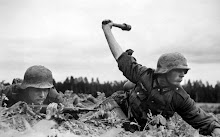
No guarantee these pics are of Barbarossa (I think the machine
gun this guy is humping is an MG-42, putting this pic post 1942)

The now familiar sounds echoing across the Eastern European plain included the whine of Stuka dive-bombers, the roar of Panzers and the endless hammer of hob-nailed boot after hob-nailed boot. With an open-ended war still raging with Britain and Free French forces in the West, Adolf Hitler had finally launched his invasion of the Soviet Union. In doing so, he hoped to rid Europe of what he perceived to be a Judeo-Bolshevik menace, and secure for the Third Reich the
lebensraum, literally "living space", it needed to assume its rightful place as the world's leading power.

But if you follow this blog, you know nothing is cooler than Germans live in technicolor.

Barbarossa, launched with 4.5 million men over a nearly 2,000 mile front, opened up the Eastern front of the European Theater of World War II. Over the next four years, more men fought over more square miles of territory, resulting in more casualties than in any other land conflict in human history, all of it done with a savage inhumanity that is nearly incomprehensible. To be sure, the war in the Pacific that began following the attack on Pearl Harbor six months later was fought over a larger area and could lay claim to being the Eastern Front's equal in sheer brutality. However, the number of men engaged in the Pacific and the casualty numbers, even with the two atomic bombings, are not even comparable.

From June 22, 1941 to Germany's surrender in 1945, most of Eastern Europe was laid to waste, resulting in the deaths of upwards of 30 million people, both in uniform and out. The siege of Leningrad; the extermination of Eastern European Jews; the battle for Moscow, which remains to date the largest battle ever fought; the infamous and pivotal battle of Stalingrad; the Soviet rape of East Prussia; and the battle of Berlin all were direct effects of Operation Barbarossa, along with countless other battles where the notoriety was more fleeting, but the death just as permanent. Not only were the depths of human depravity made evident during Barbarossa, but the borders and authorities created by its resolution would set the stage for the Cold War that would plague the world for the next 50 years.