Showing posts with label World War II. Show all posts

Tuesday, February 23, 2010

February 23, 1945

Worth A Thousand Words: Or, In Some Cases, Even More Than That.

Last Friday we mentioned that February 19th was the anniversary of invasion of Iwo Jima, the tiny hulk of volcanic rock just 750 miles south of Tokyo. Hitting the beaches with the Marines that morning was a short, bespectacled photographer for the Associated Press named Joe Rosenthal. Risking life and limb to tell the story of the struggle to the American public, Rosenthal followed the Marines inland, unwittingly about to capture one of the most iconic images in the history of photography, let alone warfare.

On February 23, 1945, Rosenthal climbed to the top of Mt. Suribachi and was fiddling with his film while some marines kicked around in the nearby debris. The men were going to put up a large American flag, replacing a smaller flag put up a little while before. Since every American in sight of the mountain had rejoiced at the first flag raising, and since the battle was still raging below the summit, Rosenthal had no idea he was about to witness a landmark in history. In fact, still not ready as the men were hoisting the pole, he thought he'd missed the whole show.

The story of the Flag Raising on Iwo Jima has been well chronicled, most notably and eloquently by James Bradley's Flags of Our Fathers. But Rosenthal's photo was not the only image of World War II to live on in history, so today, in honor of one of the Marine Corps proudest events, we'll look at some other notable photos that have outgrown the very circumstances they depict.

Confederate Dead at Devil's Den

This Confederate soldier fell in an assault on a rocky bottom near Gettysburg, Pennsylvania, in one of the decisive engagements of the American Civil War. Or so the picture would have you beleive. The photographer, Alexander Gardener, posed the dead Southerner and his rifle at the photo site; he was killed somewhere else.


Today, you can go to Gettysburg National Military Park to visit the battlefield, and pose bodies of your own.

Execution of Sergeant Leonard Siffleet

This incredible picture catches an Imperial Japanese Army officer about to behead an sickly prisoner of war. You might want to keep this sort of damning evidence to your depravity from getting out right? In fact, moments before the officer ordered a nearby soldier to snap the photo.

Raising the Banner of Victory

Incredibly, the Soviets seemed to have an Iwo Jima-like moment of their own. Two soldiers, with the smoke of the raging battle in the background, climbed to the roof of the Reichstag and raised the flag of the Soviet Union over the city of Berlin in May, 1945. Even more incredibly, a photographer was there to immortalize the act.


Not quite. The picture was taken two days after the flag was first raised over the building. The photographer Yevgeny Khaldei hand picked the two men; one Russian, one Georgian (just like Stalin). You can see in the original that smoke was later added to the image, and a watch was removed from the right wrist of the soldier below. Multiple watches were a sign of looting, and what good communist boy would need to loot a watch?

Execution of a Viet Cong Prisoner


We thought we'd finish off with this picture of Chief of the South Vietnamese National Police Nguyen Ngoc Loan executing Nguyen Van Lem, a VC officer in Saigon during the Tet Offensive. Actually, we're only posting this picture for the student in a history course at Temple University, who showed this to our Editor-in-Chief as an example of American brutality in Vietnam.

In short, war is Hell, folks. Brave men and women risk their lives every day to show us just how horrible it is. These images don't need our stories or fabrications to enhance the horrors of war. What can not be forgotten, and what so often is, is the figures in the images are real people, flesh and blood. They had dreams and fears; virtues and short-comings; wives, sweethearts, mothers. Their experiences were terrible enough, to steal a phrase from Abraham Lincoln, "far above our poor power to add or detract."

Saturday, February 20, 2010

Dead Admiral Quote of the Week

Love Your Lady.

Since we spent so much time at sea this week, we felt it was fitting to find a quote from a man who served on the waves. Commander-in-Chief of the American Pacific Fleet during World War II, Admiral Chester W. Nimitz knew a thing or two about keeping ships in fighting shape. Badly damaged by enemy planes during the Battle of the Coral Sea in May, 1942, many thought the USS Yorktown would be out of action for months. Known to her crew as "The Fighting Lady, Nimitz's ordered repairs on the flattop to be carried out around the clock, making her seaworthy in time for the pivotal Battle of Midway, fought just a few weeks later. Tongue planted firmly in cheek, Nimitz suggested how the process related to an old nautical tradition:

A ship is always referred to as a she because it costs so much to keep one in paint and powder.


Wednesday, February 17, 2010

February 17, 1871

Passez la Champagne: Or a Conqueror's Guide to Paris.

Today we once again turn to our Gallic brethren to provide us with a chance to look at one of those events that seems to repeat itself throughout military history. Few cities in the world have the majesty, culture, and history of Paris, and surely few have evoked as much awe, envy, and even contempt. Throughout her history, the city on the Seine has been the target of a number of invaders and would-be conquerors.

Prussian soldiers march through Paris after the end of the Franco-Prussian War, February, 1871.

On February 17, 1871, Prussian troops celebrated their victory in the Franco-Prussian War with a parade past the Arc de Triomphe. The demonstration capped celebrations following the coronation of Wilhelm I, the first German Emperor. Fought mostly to unite Germany's southern kingdoms with Prussia against a common foe, the war was neither the first nor last period that saw foreigners march through Paris. To shake things up today, we'll take a look at some of the darker days in the City of Light.

52 BC:
During his conquest of Gaul, Julius Caesar crushes a local uprising led by the legendary Vercingetorix on the left bank of the Seine. A nearby settlement, named for the Parisii people, is renamed Lutetia by the Romans and begins growing rapidly.


Caesar is still in Paris, but only at the Louvre.


1420 AD:
During the Hundred Years' war, and after years of local popular uprisings, the English under Henry V capture Paris. Henry VI is crowned King of France at Notre Dame in 1429, and the English hold the city for seven more years.

The coronation of English King Henry VI as King of France. Note the fleur-de-lys on his crest.

1814:
After Napoleon's failed invasion of Russia, his enemies in the east followed him back to France, culminating in a parade through Paris. Czar Alexander I was at the head of the column.

Russians parade though the city after the War of the Sixth Coalition against Napoleon in 1814.

1871:
Following a four-month siege of the city, Prussian troops enter Paris, resulting in the coronation of Wilhelm I, and yet another parade. Here is an awesome description of the first Prussians entering the city, originally published in Blackwell Magazine and reprinted in the New York Times, December 10, 1893:

[One] came tearing up the hill. As he neared we saw he was a hussar officer...He charged past us, his sword uplifted, his head thrown back, his eyes fixed straight...By Jove if that fellow's mother could see him, she'd have something to be proud of!

The youngster raced on far ahead...[to] the Arch of Triumph...We caught sight of him on the other side through the archway, his sword high up, as if he were saluting the vanquished city at his feet.


The coronation of Wilhelm I, held in the Hall of Mirrors at Versailles, 1871.

1940:
After the Germans failed to capture the city during the First World War, Adolf Hitler makes sure Gay Paree sees the indemnity of a Wehrmacht parade in the Second. Later, with Allied armies closing in, Hitler orders the city to be destroyed, but Paris is spared by the military governor General Dietrich von Choltitz.

Hitler found the exact railroad car in which the Germans signed their surrender in 1914, and used it to hold the ceremony in reverse in 1940.

To be sure, Paris' position as the envy of Europe has put it in some perilous spots in the past. The last time foreign soldiers paraded through her streets, it was on a much more joyous note. On August 25, 1944 American troops, spearheaded by Free French forces, marched into the city to end the German occupation.


Americans march through Paris after the liberation in 1944. That familiar landmark is just visible in the background.

Friday, February 12, 2010

February 12, 1946

The U-Boat Graveyard: Or Why Germany Has To Stay in the Shallow End.

Well, we're almost afraid to show our faces around these parts lately, given this blog's laughable rate of production, but all the same we're proud to say that Lies Agreed Upon is back with a bang here in the middle of February. Call it a Valentine's Day gift to our wonderful readers, whose French sensibilities are soothed by the romantic. All the same, we appreciate your patience during this apparent "work stoppage."

We dive right back into the water today, and turn back the clock to a war ravaged Europe less than a year after Adolf Hitler's Third Reich had collapsed into rubble. One of the many steps it would take to rebuild the continent was getting rid of the countless pieces of war that Germany suddenly no longer needed. Tanks, vehicles, guns, planes (if there were any left), small arms; all the surrendered working parts of a war machine that had been dismantled. Included in the tally were over 154 vessels of the Kriegsmarine's prized U-Boat fleet.


Officers salute from the tower as U-107 sets out from Lorient, France, 1942.


U-Boats or Unterseeboote, were the scourge of the blue water at one point in the war, and for that matter, played the same role a generation before. Pan-European conflicts tend to make land powers like Germany susceptible to blockade, particularly when the British are fighting on the other side. Under both Hitler and Kaiser Wilhelm II, the Germans turned to unrestricted submarine warfare to break the blockade and cut England's lifeline to the outside world.

We enjoy the debate on the effectiveness of this tactic for two reasons, the first of which is the reaction of the United States. In both wars, U-Boats succeeded in sinking millions of tonnage and likely cost billions of dollars in losses, but in both conflicts they caused Germany to incur the wrath of a growing superpower. In 1917, knowing full-well what the response would be, the Germans unleashed their unrestricted subs on American ships and brought the U.S. into the war. Prior to Pearl Harbor, German wolf packs, or groups of subs, hunted in waters as far West as the Gulf of Mexico. This succeeded only in driving the U.S. to aid the Allies to the point of undermining her status as a neutral.

The sinking of the RMS Lusitania in 1915 caused outrage in the United States, and the Germans halted their unrestricted submarine warfare. When it resumed in 1917, it drove the US to enter the war.

To us, the cost of bringing an immensely powerful enemy into the fray is not covered by the success the subs did have. But what really pique's our interest about the U-Boat is the fact that Germany had to turn to them at all. Looking back, it was the build up of the Imperial German surface fleet that first alarmed Europe's established powers. At the turn of the 20th Century, the Kaiser's desire to launch a fleet to rival England's posed a challenge to the long recognized ruler of the waves. Yet when hostilities broke out, Germany was out of her league at sea and her new ships spent most of the war bottled up in port. As it happened, the oceans would be her downfall.

It was the oceans that brought the supplies an exhausted Britain needed to survive until 1918; that brought millions of fresh American troops when the First World War was still very much in doubt; that saved England from invasion after Dunkirk; that kept supplies from Rommel in North Africa; that carried thousands of tanks and planes to the Soviet Union on the frigid "Murmansk Run"; and it was from over the oceans that wave after wave of Allied troops came to places like Casablanca, Salerno, and Normandy.

Germany's designs on a surface fleet made her persona non grata at the European power table, but she never built an armada even close to what was feared. Because of this, she was forced to dive below the surface in two World Wars, thus creating more enemies than she could handle. On February 12, 1946, a little over nine months after the U-Boat fleet was surrendered, over 120 German submarines were scuttled in Operation Deadlight; blown up and sunk intentionally off the coast of Northern Ireland.


52 U-Boats are prepared for scuttling as part of Operation Deadlight, February 1946.


Germany had long desired a world renowned fleet, and the one scuttled in Deadlight was infamous indeed. But designs on a navy caused an exhaustive world war and planted the seeds for the vengeance-fueled second. The fleet they got might not have been exactly the one the Germans pictured, but it brought on a host of enemies just the same. When the U-Boats were finally scuttled it was the end of a sad chapter in naval history, and closed the book on Germany as a world naval power.

Saturday, December 12, 2009

Dead General Quote of the Week

On the Field and In the Field.

In honor of the Army-Navy game being played in Philadelphia today, for this Dead General Quote of the Week we turn to General George C. Marshall, Chief of Staff of the United States Army during World War II:

I want an officer for a secret and dangerous mission. I want a West Point football player.


Go Navy. Beat Army.

Monday, November 30, 2009

November 30, 1939

A Bad Dress Rehearsal: Or is the Enemy of My Enemy My Friend?

Today we start the new week and end the month of November with one of those small, sometimes forgotten dances that opened up the waltz of the Second World War. By 1945, Anglo-American troops had linked up with the Soviet Red Army, cutting Germany in half and linking the great Allies of east and west. History remembers these two forces combining to rid the world of the Third Reich, but some neglect that at the start of hostilities, the two sides almost became enemies.

Before the first German blitzkriegs were launched across Poland, Nazi and Soviet leaders had signed a mutual non-aggression pact that freed the two distrusting states of the immediate fear of a conflict with each other. This allowed both sides to pursue engagements elsewhere, even though each viewed the other as their main threat. While Hitler turned his eyes to the Western Allies that had shamed Germany after World War I, Stalin sought to reclaim Soviet territory lost to Finland during the Bolshevik Revolution a generation before.

His prime concern was with the city of Leningrad, in the extreme western reaches of the new communist empire. Stalin felt the namesake of his mentor could only be properly defended by reacquiring the lost territory. Also, while the Soviets and Finns had a non-aggression pact of their own, Stalin had noticed that almost none of the rapidly growing Finnish foreign commerce was coming across the border to the Soviet Union. Citing the potential conflict with Germany, he demanded that neutral Finland cede former Russian territory back to its rightful owner. The Finns flatly refused.

In late November, 1939, the Soviets claimed some of their troops had been shelled by Finnish forces near the border town of Mainila. When the Finns suggested the two countries investigate the incident, the Soviets feigned outrage and renounced the peace treaty between the two nations. On November 30, 1939, Red Army troops stormed across the border and Soviet planes bombed Helsinki, the Finnish capital. The short but ill-fated Winter War had begun.

Finnish ski troops man a trench during the brief but intense Winter War. While the Finns' clothing camouflaged them in the snow, many Red Army units began the war without cold weather gear.

Stalin, in all his paranoid wisdom, had quite successfully rid the Red Army of almost all its most experienced officers during the Great Purge the year before. Nevertheless, he felt his enormous army could easily beat back the outnumbered Finns and reclaim the territory he sought. The fact that Stalin was launching his invasion at the start of the Finnish winter and his men were attacking an enemy defending its homeland seemed lost on the dictator. As usual the lives of Red Army troops would foot the bill for Stalin's dreams of conquest.

The Soviets were woefully unprepared to fight such a campaign. With their best generals either dead or in Siberian gulags, the senior leadership in the Red Army was in shambles. Furthermore, the winter of 1939-40 was one of the coldest in Scandinavian records. All that, combined with the relentless determination of Finland's sons meant the easy war envisioned by the Red Army was far from the reality. By the end of the four month conflict, nearly 400,000 Russians had become casualties.

The West, for its part, was just as shocked at Stalin as it had been at Hitler earlier in the decade. This time, however, they planned to stop a hungry dictator before he took too healthy a serving for his plate. Aid poured in from many western nations, including Nazi Germany. Russia was booted from the League of Nations, and thousands of foreign volunteers made their way to Finland. The French and British, hoping to simultaneously cut Hitler's access to Scandinavian iron ore and to keep the fighting far from home soil, both planned to send troops to aid the smaller nation's cause.

The dogged Finnish defenders, however, could not hold back the Russian steamroller indefinitely. By the time spring had broken, the Red Army had secured the land Stalin felt was necessary to defend Leningrad. A fragile peace was arranged, but the Soviets could not escape the double indemnity of being viewed as both the aggressors and militarily incompetent. The Winter War would usher in more wholesale changes to the Red Army command structure, not all of which would be completed by the time the Germans invaded in 1941.

Broken Russian bodies and equipment litter Raate Road, the only line of escape for Red Army units trapped deep in Finnish territory during the Winter War.

Despite its brevity, the Winter War had lasting effects on the newly begun Second World War. Finland would not forget Russia's transgressions, and joined with Hitler once Operation Barbarossa was launched. Tensions between the west and the Soviet Union would remain until the Germans made them allies out of necessity. The Red Army would eventually regain its footing to throw back the Nazi invaders and emerge as the West's menace during the Cold War. Nevertheless, its first preparations for the rapidly approaching war nearly ended in disaster.

Saturday, November 28, 2009

Dead General Quote of the Week

Bold Predictions

After leading the successful but costly invasion of Tarawa, General Holland M. "Howlin' Mad" Smith would find himself commanding at another bloody stop on the island hopping campaign. Waiting off the coast of Iwo Jima in February, 1945, Navy commanders asked Smith to appraise how his men would fare on the island:

This will be the bloodiest fight in Marine Corps history. We'll catch seven kinds of hell on the beaches, and that will be just the beginning. The fighting will be fierce, and the casualties will be awful, but my Marines will take the damned island.


Wednesday, November 25, 2009

November 24, 1944

The End of an Era: Or How Do You Say Wild Blue Yonder in Chinese?


Yesterday we covered the bloody invasion of Tarawa, the first stepping stone in the island hopping campaign aimed at the heart of Japan. As we discussed, the ultimate goal of creeping closer to Tokyo island by island was to secure airbases and jump off points close to the Japanese mainland. By late 1944, the Marines had finally captured airfields that brought the home islands into the range of the B-29 Superfortress, America's new heavy bomber. Soon after, relentless air attacks would hit Japan from over the ocean, dealing death on daily basis after racing down out of the rising sun.

Before that, however, the task of bombing Japan was the charge of the United States Twentieth Army Air Force, stationed at a far off series of airbases near Chengtu in central China. On the far side of the world, 10,000 miles from Washington, D.C., the Twentieth Air Force had been taking the war to the Japanese homeland since the start of 1944. Using four groups of B-29s, the Twentieth Air Force was personally commanded by General Henry H."Hap" Arnold, Chief of the Army Air Forces.


Kumming Air Base, China, in 1944. B-29s from the XX Bomber Command, Twentieth Air Force took off from this field and others like it before bases opened in the Marianas.


Supplies to the base had to be airlifted via "The Hump", the high altitude supply line from India over the Himalayas, and not all the equipment the Twentieth needed always arrived. With Arnold at the helm, the Twentieth developed a knack for resourcefulness, ingenuity and inventiveness. That, combined with the distance from home and the dangerous nature of their mission meant that a unique attitude developed on the airbases near Chengtu. Perhaps the farthest flung of all American troops across the globe, the airmen developed a cocky, colorful yet workmanlike demeanor.

On November 24, 1944, the first B-29s took off for Tokyo from the island of Guam in the central Pacific. For the Twentieth, still launching raids on Japan in Operation Matterhorn, it was the beginning of the end of the flyboy haven on the other side of the world. With island airfields large enough to handle the giant bombers, the daunting logistics that came with raiding the enemy's home were eased. The lifeline of a B-29 over Japan no longer had to stretch from China, over Everest, through India and across two oceans. With bases in the Marianas, planes, pilots and munitions could all be delivered by the United States Navy who now controlled the Pacific.

When most think of the bombings of Japan, familiar images include formations of B-29s taking off from airfields on the widespread islands of the Pacific. To be sure, most of the destruction suffered by Japanese cities was yet to come, hand delivered by American boys who had launched from places like Guam, Tinian and Saipan. The Twentieth Air Force itself would even transfer to the Marianas to continue their work for the rest of the war. But lost to the deathly efficiency of these raids is another story of men fighting on the far side of the world.

B-29s drop incendiary bombs on Japan, 1945.

Deep in the Asian mainland, with the entire Japanese war machine between themselves and their homes, they paved the way for the bombing campaign that would eventually bring the war to a close. All the while, they bred a unique environment, where skill and initiative and guts trumped dogma and spit and polish. True, they were far more effective later from the Marianas, and their huge requisitions dogged the overburdened airlift, but the story of the Twentieth Air Force in China is not to be forgotten.

Monday, November 23, 2009

November 23, 1943

Blood on the Coral: Or the Most Expensive Square Mile in the Pacific.

We start the new week at Lies Agreed Upon with one of the more infamous battles in the Pacific Theater of World War II. The tiny atoll of Tarawa, in the Gilbert Island chain nearly 2,400 miles southwest of Pearl Harbor, was seen by American commanders as a vital step in the island hopping campaign across the Central Pacific. Planners had their sights set on the Marianas Islands, another 2,000 miles further west, to establish the airbases needed to take the war to the Japanese home islands. Standing in the way was the heavily armed garrison on Tarawa's Betio Island, a spit of rock with an area less than a square mile.

Landing troops on a hostile shore, protecting them while they unload equipment and then keeping them supplied is often considered the most difficult operation a force can attempt. These challenges were compounded at Tarawa for several reasons. First, the beaches of the island are only accessible from the shallow lagoon the atoll surrounds. Approaching from the sea is impossible. Furthermore, the tides around the Gilberts are notoriously fickle, and at times hide jagged coral reefs that can rip the bottoms right out of landing craft.

Marines storm an enemy pillbox on Tarawa.

In addition, Tarawa was occupied by 5,000 men of a special naval detachment, essentially Japanese marines. These elite troops spent over a year creating an interwoven web of trenches, bunkers and pillboxes. The difficult task of assaulting Tarawa fell to the men of the 2nd Marine Division. During the inter-war period, the United States Marine Corps had pioneered the art of amphibious landings on beaches all over the Caribbean. The few offensive landings undertaken since the start of the war had not been contested on the beaches by the Japanese. The landings on Tarawa in late November, however, would put the Americans to the ultimate test.

The first wave of Marines was met at the water's edge by heavy machine gun and mortar fire. They would be forced to fight their way onto the island, but they were ashore and organizing at the base of a seawall on the beach. As the second wave approached, the predicted tides failed to change and landing craft had to dump their men and equipment nearly a hundred yards out to sea. Men laden with nearly half their body weight in gear were forced to wade through chest-high water under fire. By the time the third wave arrived, the distance was nearly five times that. The first wave was hit hard; the second decimated; the third nearly destroyed.

The problems did not end once the Marines got off the beach. The well planned defensive network proved its worth over the course of the next three days, exacting a bitter price for each yard the Americans advanced. Nevertheless, the typical marine bravado was evident throughout the battle. During the fighting, a report by Colonel David. M. Shoup, who would eventually become the Commandant of the Marine Corps, summed up both the combat and the attitude of the Marines: "Casualites: many; Percentage of dead: not known; Combat efficiency: we are winning."


Colonel David M. Shoup, shown here with his trademark cigar, won the Medal of Honor for his actions on Tarawa.


By November 23, 1943, through incredible bravery, overwhelming firepower and sheer grit, the Marines had cleared the island. Afterward, for one of the first times ever, the American public was allowed access to the gruesome details of the savage war in the Pacific. The "butcher's bill" at Tarawa would be shocking, as in just three days of fighting casualties in many units topped 50 percent. Up to that point, it was the costliest battle in the history of the Marine Corps. A short documentary, With the Marines at Tarawa, was released the next year, and Americans found themselves aghast at the deadly carnage their sons faced on a daily basis. Of the 5,000 Japanese on the island, only about 150 were taken alive.

After the battle, the huge casualty numbers caused many to question not only the necessity of the fight, but the conduct of the war as a whole. Marine General "Howlin' Mad" Holland Smith later wrote "Was Tarawa worth it? My answer: an unqualified No." Smith blamed the casualties on poor planning and a lack of understanding of tides in the Gilberts. He felt Tarawa could have been bypassed and the Japanese defenders left to "wither on the vine." Nevertheless, the Marines proved that any island could be taken by an amphibious assault, regardless of the number of defenders or the extent of their fortifications. The lessons learned at Tarawa would prove invaluable on the long road to Tokyo.

This grisly scene was repeated all along the shores of Tarawa in late November, 1943. It was the first time the Japanese had contested an American landing at the water's edge.

Thursday, November 19, 2009

November 19, 1941

A Long Way From Home: Or Why They Call It a World War.

We've got good news and we've got bad news. We went to bed last night making a promise to our readers about a few irritated communists and maybe a T-34 or two. We hate to do it, but we're backing out on that. We woke up this morning realizing we had just done pissed-off Russians two days ago, and would thus be luring our reader into the same trap as yesterday's. Fortunately, (for us more than our audience) we have come across another one of those little stories that end up serving as a microcosm for war as whole.

Captain Theodor Detmers, a twenty year veteran of the German
Kriegsmarine, must have thought his luck had run out early in the evening of November 19, 1941. He was skippering the auxiliary cruiser Kormoran, a blue water commerce raider that had been at sea for nearly a year. In the bountiful eastern Atlantic, his ship had executed a impressive run of successful raids. But as they passed the Cape of Good Hope and neared the coast of western Australia, their haul had dried up.


Captain Theodor Detmers, skipper of the Kormoran.


The Kormoran was struggling with a malfunctioning engine, and had not made contact with any enemy ship for months. Detmers planned to deploy a complement of sea mines before leaving the Pacific and returning home for repairs. He barely avoided an Australian convoy off Cape Leeuwin, but then on the evening of the 19th, sailed right past the light cruiser HMAS Sydney. Intercepted by the faster and better armed Sydney, Detmers disguised his vessel as a Dutch merchant ship. Now, the Sydney was so close, he could see Australian sailors moving around on her decks.

Detmers was puzzled, too. This warship, which easily out-gunned his disguised raider, was bearing down on him just off his starboard beam. Now, she had hoisted the letters IK, warning him to prepare his ship for a hurricane. In the serene waters off of western Australia, Detmers had no idea what the signal meant and had no idea how to answer it. After fifteen minutes of nerve-shattering tension, the
Sydney signaled "Show your secret sign", and Detmers knew his ship was in trouble.

The Kormoran in 1940, pictured here from the deck of a German U-Boat.

The fact that Detmers was even in this situation is what we'd like our readers to pause and think about today. At this point in the war, Germany had tasted very little defeat practically anywhere. With France overrun, England stood alone in the west, and Hitler had bailed out his ally Mussolini in Greece. Russia was on its heels, although the Germans were running into stiff resistance in front of Moscow. In North Africa, they were pushing on Tobruk. In the Pacific, a secret Japanese task force was just a week away from sailing for Pearl Harbor.

Still in its infancy, the Second World War had truly earned its name. Take Detemers' stand-off, for example. A German commerce raider, nearly 8,000 miles from its home port, was staring down the barrels of an Australian cruiser, on its way home from a tour of duty in the Mediterranean. Elsewhere, Japanese boys were in China; Americans were in the Philippines and on Wake Island; Italian soldiers were stuck in the Libyan sand dunes, and the young men of the British Isles were in places as far flung as India and New Guinea, while fending off the
Luftwaffe in the skies over Europe.

It is hard to imagine such a scenario today, most of the world at war in all corners of the globe, with more nations and more territory soon to be thrown in. By 1945 there had been at least some fighting on six of seven continents and on all four of the oceans. The sheer number of people involved and the size of the military machines required to sustain that effort is something we cannot comprehend today. There were times when it seemed no one, no where, could escape the war.

Certainly, Captain Detmers could not escape it, and by 5:30 pm on the 19th he had a decision to make. Obviously, the
Sydney was challenging him with some sort of code. Unable to produce the correct response, Detmers had only one choice. What happened next was later pieced together with accounts from the survivors of the Kormoran.

Detmers ordered his men to run up the German colors and open fire on the
Sydney. The Australian ship, finally realizing who she was along side, fired almost simultaneously. But the cruiser had come in too close, or her guns were still sighted for a warning salvo. Her first volley mostly flew over the smaller German craft. The Kormoran, however, didn't miss. Her salvos were raking the enemy fore to aft. The Sydney fired away for nearly half an hour, eventually damaging the raider, but was struck by a German torpedo and forced to retire.

Detmers' craft had fended off the bigger vessel, but with no safe port anywhere in reach, the Captain ordered his men to abandon their burning ship. 318 of the 399 German sailors would await rescue in lifeboats for days. On the night of November 19, the sky above them was lit by the fires aboard the
Sydney, slowly dying somewhere beyond the horizon. The cruiser sunk sometime after that, and none of the 645 Australian sailors was ever found.


Crew of the HMAS Sydney before the war.

Afterward, the Australian government would launch inquiries into the case of the Sydney, trying to determine what events had caused such a superior ship to be sunk by an inferior enemy. Few clear conclusions were drawn, and some accused Detmers of firing before revealing his German colors. Survivor accounts refute that, and it is most likely the damage from the enemy torpedo did in the Sydney and her crew. Either way, Detmers was an Australian prisoner, and sat out the greatest conflict in human history far from home on the other side of the world.

Monday, November 16, 2009

November 16, 1940

Erasing the Front Line: Or a Look at War as We Know It Today.

After a long layoff, Lies Agreed Upon returns to examine one of the more unfortunate chapters of military history, and modestly attempts to trace the path belligerent nations took to change the face of warfare as we know it. During the First World War, the newly invented airplane took a backseat to conventional ground and naval tactics. In the generation between that war and the next, however, military leaders ensured that rapidly evolving aircraft would play an ever-increasing role in the conduct of war.

While many doubted that airplanes had any military importance at the start of hostilities in 1914, by the fall of 1940 it was clear that the future of warfare was in the sky. With devastating effectiveness, the Luftwaffe had cleared the way for German panzers to bulldoze a path across most of Poland, the Low Countries, and France. Without a naval force large enough to challenge his enemy's dominance on the waves, Adolf Hitler once again turned to his air force to reduce Great Britain, his last challenger in Western Europe.


Stuka dive-bombers became a symbol of the German Blitzkrieg. While lethal against ground targets, they were essentially useless in air-to-air combat.


In May of 1940, in complete control of the Continent, Hitler launched wave after wave of bombers in an attempt to subdue the British and prepare for a cross-Channel invasion. Initially, the Germans targeted shipping and munitions plants, but led by the indomitable Winston Churchill, the British resolve failed to waver. German strategy would have to change.

Soon, they began targeting civilian areas, hoping to demoralize the population and blast the British right out of the war. On November 14, 515 German bombers attacked Coventry in one of the most destructive raids seen during the Battle of Britain. Two days later the British enacted their revenge.

A little after midnight on November 16, 1940, 200 bombers of the Royal Air Force rumbled their way over Hamburg, Germany, leveling parts of the city. It was not the first raid on Hamburg, nor was it the most devastating night the area would see during the war, but the raid was launched in direct response to the raid on Coventry. For the first time, even though they claimed the moral high-ground over the modern day "Huns", the British carried out an attack with the express purpose of targeting German civilians. War, as it was known at the time, was changed forever.

Hamburg, pictured here at the end of the war, was one of the many victims of the Allied Combined Bomber Offensive. Particularly effective was a new weapon first used by the Allies in 1944: napalm.


It had become increasingly clear during the first years of the Second World War that civilians were no longer safe in their homes behind the front lines. The German and Japanese genocides in their conquered territory hinted at this, but the Battle of Britain confirmed it beyond all doubt. Not only did airplanes make civilians living near military targets vulnerable, but as the war progressed they found themselves liable to be targeted directly. Over 50,000 residents of Hamburg were killed as a result of the Allies' Strategic Bombing campaigns.

In centuries past, Western warfare was limited to opposing armies meeting on a clear field of battle. While the landscape was open to devastation, civilians generally found themselves out of bounds. As war changed, and concepts of total war came into play, civilians saw every aspect of their lives geared toward arming, clothing and feeding a far-off army. With the advent of the airplane as a major weapon, however, civilians found themselves just as likely to be killed as men in uniform.

At the outset of World War I, few commanders believed aircraft could be used even for reconnaissance, let alone for aerial combat. In less than twenty-five years, military aviation had evolved to be the most important factor in a nation's ability to project power. The Battle of Britain was the first large-scale air battle in history. Eighteen months after the raid on Hamburg, the Americans and Japanese fought the first naval engagement to only involve aircraft in the Battle of the Coral Sea. A few years later, the war came to a conclusion in the clouds above Hiroshima and Nagasaki. In just five years, and only a generation after flight was first used in combat, the face of war underwent a complete overhaul.

The Second World War was the first major conflict to see a higher number of civilians become casualties than combatants. Civilian deaths have outnumbered military deaths in every single major conflict since.

Monday, June 22, 2009

June 22, 1941

Operation Barbarossa: Or Das Lange Krieg.

In the predawn hours of June 22, 1941, a sound that had become familiar in Western Europe finally rumbled its way into the East. From the early summer stillness that Sunday morning erupted the largest land invasion in history, the culmination of more than a thousand years of soc
io-ethnic tension and the catalyst of the most destructive war in human history.


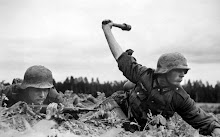
No guarantee these pics are of Barbarossa (I think the machine
gun this guy is humping is an MG-42, putting this pic post 1942)

The now familiar sounds echoing across the Eastern European plain included the whine of Stuka dive-bombers, the roar of Panzers and the endless hammer of hob-nailed boot after hob-nailed boot. With an open-ended war still raging with Britain and Free French forces in the West, Adolf Hitler had finally launched his invasion of the Soviet Union. In doing so, he hoped to rid Europe of what he perceived to be a Judeo-Bolshevik menace, and secure for the Third Reich the
lebensraum, literally "living space", it needed to assume its rightful place as the world's leading power.

But if you follow this blog, you know nothing is cooler than Germans live in technicolor.

Barbarossa, launched with 4.5 million men over a nearly 2,000 mile front, opened up the Eastern front of the European Theater of World War II. Over the next four years, more men fought over more square miles of territory, resulting in more casualties than in any other land conflict in human history, all of it done with a savage inhumanity that is nearly incomprehensible. To be sure, the war in the Pacific that began following the attack on Pearl Harbor six months later was fought over a larger area and could lay claim to being the Eastern Front's equal in sheer brutality. However, the number of men engaged in the Pacific and the casualty numbers, even with the two atomic bombings, are not even comparable.

From June 22, 1941 to Germany's surrender in 1945, most of Eastern Europe was laid to waste, resulting in the deaths of upwards of 30 million people, both in uniform and out. The siege of Leningrad; the extermination of Eastern European Jews; the battle for Moscow, which remains to date the largest battle ever fought; the infamous and pivotal battle of Stalingrad; the Soviet rape of East Prussia; and the battle of Berlin all were direct effects of Operation Barbarossa, along with countless other battles where the notoriety was more fleeting, but the death just as permanent. Not only were the depths of human depravity made evident during Barbarossa, but the borders and authorities created by its resolution would set the stage for the Cold War that would plague the world for the next 50 years.