Showing posts with label Napoleon. Show all posts

Monday, February 22, 2010

February 22, 1797

Close But No Cigar: Or, When Will They Build the Chunnel?

We start the new week at Lies Agreed Upon by turning our attention to that tiny arm of the Atlantic that always seems to cause so much trouble for Europe's continental powers. At it's narrowest point, the English Channel separates Great Britain from France by a scant 21 miles. Yet this distance, lengthened by the renowned British sea power, has stymied countless invasion attempts, once prompting this quote from our boy Napoleon. Ask the sailors of the Spanish Armada just how difficult the task can be.

An American fighting for France is not an unfamiliar story to some of our readers, but few Yanks have fought under quite the same circumstances as Colonel William Tate. A South Carolinian of Irish descent, Tate's family had been murdered by pro-British Indians during the American Revolutionary War. In Paris after the war, the advocate of Irish Republicanism felt the best way to get back at the crown was to take up arms again.

Two frigates and two corvettes made up the French squadron, sailing under Russian colors, that set out from Brest in 1797 on the last invasion of Great Britain.

In January, 1797, as Napoleon Bonaparte prepared for his first invasion of Italy, a large French force had set out from Brest to land in Ireland. Hoping to incite the Emerald Isle's anti-British fervor, the weather (not the Royal Navy) forced the French to turn back. In spite of this, a smaller diversionary landing went ahead as scheduled.

Tate had been given command of the French Second Legion, 1,500 troops known as the Legion de Noire because of their distinctive dark uniforms. Even after the failed Irish Expedition, they slipped into the Channel aboard four French ships, hoping to land near Bristol on Britain's western coast. Bad weather forced them further north, and on February 22, 1797, Tate's men disembarked near Fishguard, Wales, the last foreign invaders to successfully land on British shores.

His ill-fated campaign was doomed almost from the outset. Among the Black Legion were over 600 irregulars, convicts who dispersed soon after landing to loot the local towns. Tate's problems were compounded by the discovery of stores of wine rescued from a Portuguese shipwreck by the locals a few weeks before. When British forces, made up mostly of volunteers, appeared before him the next day, Tate's command was severely depleted.

Tate arrayed his small force in strong defensive positions to face the oncoming enemy. Under command of John Campbell, 1st Baron Cawdor, the British initially planned to drive the French back into the sea. With only three cannon, however, Cawdor avoided a potentially deadly ambush when he held his men in the village for the evening. That night, their disheartened men scattered by drink and temptation, two French officers made their way into the town to negotiate a surrender.

The Royal Oak Pub in Fishguard, site of the British headquarters and French surrender negotiations during the brief invasion.

The next afternoon, with most of the town of Fishguard turned out to see them, the French forces laid down their weapons and began a march to prison camps in England. The last invasion of Great Britain ended almost without a shot, and the British even captured two of the four invasion ships. Local legend credits Jemima Nicholas, a townswoman armed only with a pitchfork, with the capture of 12 drunk French soldiers.


The grave marker of Jemima Nicholas, Fishguard, Pembrokshire, Wales.


Since the short lived landing at Fishguard, the English Channel and the Royal Navy have not only safeguarded Great Britain, but also caused her enemies to take on other daunting campaigns. Lord Horatio Nelson's victory at Trafalgar in 1805, for example, would come at the expense of French squadrons attempting to consolidate in preparation for a cross-Channel invasion. In 1940, German planes could not clear a path for the Kriegsmarine, nor knock the British out of the Second World War. In both cases, the conquest of Western Europe was halted by a narrow strip of water, a distance a well-trained army can negotiate in a single day's march.

Sunday, February 21, 2010

Shameless Napoleon Quote of the Week

February 21-27, 2010

The first virtue in a soldier is endurance in the face of fatigue. Courage in the face of the enemy is only second.

Napoleon Bonaparte

Wednesday, February 17, 2010

February 17, 1871

Passez la Champagne: Or a Conqueror's Guide to Paris.

Today we once again turn to our Gallic brethren to provide us with a chance to look at one of those events that seems to repeat itself throughout military history. Few cities in the world have the majesty, culture, and history of Paris, and surely few have evoked as much awe, envy, and even contempt. Throughout her history, the city on the Seine has been the target of a number of invaders and would-be conquerors.

Prussian soldiers march through Paris after the end of the Franco-Prussian War, February, 1871.

On February 17, 1871, Prussian troops celebrated their victory in the Franco-Prussian War with a parade past the Arc de Triomphe. The demonstration capped celebrations following the coronation of Wilhelm I, the first German Emperor. Fought mostly to unite Germany's southern kingdoms with Prussia against a common foe, the war was neither the first nor last period that saw foreigners march through Paris. To shake things up today, we'll take a look at some of the darker days in the City of Light.

52 BC:
During his conquest of Gaul, Julius Caesar crushes a local uprising led by the legendary Vercingetorix on the left bank of the Seine. A nearby settlement, named for the Parisii people, is renamed Lutetia by the Romans and begins growing rapidly.


Caesar is still in Paris, but only at the Louvre.


1420 AD:
During the Hundred Years' war, and after years of local popular uprisings, the English under Henry V capture Paris. Henry VI is crowned King of France at Notre Dame in 1429, and the English hold the city for seven more years.

The coronation of English King Henry VI as King of France. Note the fleur-de-lys on his crest.

1814:
After Napoleon's failed invasion of Russia, his enemies in the east followed him back to France, culminating in a parade through Paris. Czar Alexander I was at the head of the column.

Russians parade though the city after the War of the Sixth Coalition against Napoleon in 1814.

1871:
Following a four-month siege of the city, Prussian troops enter Paris, resulting in the coronation of Wilhelm I, and yet another parade. Here is an awesome description of the first Prussians entering the city, originally published in Blackwell Magazine and reprinted in the New York Times, December 10, 1893:

[One] came tearing up the hill. As he neared we saw he was a hussar officer...He charged past us, his sword uplifted, his head thrown back, his eyes fixed straight...By Jove if that fellow's mother could see him, she'd have something to be proud of!

The youngster raced on far ahead...[to] the Arch of Triumph...We caught sight of him on the other side through the archway, his sword high up, as if he were saluting the vanquished city at his feet.


The coronation of Wilhelm I, held in the Hall of Mirrors at Versailles, 1871.

1940:
After the Germans failed to capture the city during the First World War, Adolf Hitler makes sure Gay Paree sees the indemnity of a Wehrmacht parade in the Second. Later, with Allied armies closing in, Hitler orders the city to be destroyed, but Paris is spared by the military governor General Dietrich von Choltitz.

Hitler found the exact railroad car in which the Germans signed their surrender in 1914, and used it to hold the ceremony in reverse in 1940.

To be sure, Paris' position as the envy of Europe has put it in some perilous spots in the past. The last time foreign soldiers paraded through her streets, it was on a much more joyous note. On August 25, 1944 American troops, spearheaded by Free French forces, marched into the city to end the German occupation.


Americans march through Paris after the liberation in 1944. That familiar landmark is just visible in the background.

Sunday, February 14, 2010

Shameless Napoleon Quote of the Week

February 14-20, 2010

[When he died], Bonaparte offered up to God the mightiest breath of life that ever animated human clay.
Francois Rene de Chateaubriand

Sunday, January 24, 2010

Shameless Napoleon Quote of the Week

January 24-30, 2010

Wherever wood can swim, then I am sure to find this flag of England.


Napoleon Bonaparte

Sunday, December 20, 2009

Shameless Napoleon Quote of the Week

December 20-26, 2009

Four hostile newspapers are to be more feared than a thousand bayonets.
Napoleon Bonaparte

Sunday, December 13, 2009

Shameless Napoleon Quote of the Week

December 13-19, 2009

I considered Napoleon's presence in the field equal to 40,000 men in the balance.


The Duke of Wellington

Sunday, December 6, 2009

Shameless Napoleon Quote of the Week

December 6-12, 2009

He who can control the English Channel for six hours can control the world.


Napoleon Bonaparte

Saturday, November 28, 2009

Shameless Napoleon Quote of the Week

November 29- December 5, 2009

God is on the side with the best artillery.


Napoleon Bonaparte

Friday, November 20, 2009

Shameless Napoleon Quote of the Week

November 22-28, 2009

Some people can move, and some people can shoot. But when you can move and you can shoot, you and Napoleon are pissin' in the same puddle.


George S. Patton

Wednesday, November 18, 2009

November 18, 1803

Ici Nous Allons Encore: Or Here We Go Again.

It's almost shameful, really, but we've done it again. It seems we here at Lies Agreed Upon are such Bonipartists that we can't even go a day without covering a Napoleonic event. Some may say we're too enamored with the Little Dictator for our own good. We'll just say it's more of a thank you to our reader(s), all of whom are fluent in French and know where to find excellent brie. We're loyal to our fans here at Lies Agreed Upon, what can we say?

But of course, we cannot possibly cover the French two days in a row without highlighting two defeats in a row. So today we look at the fight for Fort Vertieres, a French stronghold on the island of Hispaniola, the last battle in the Haitian War for Independence. When the French surrendered to rebel forces on November 18, 1803, it paved the way for the establishment of what is now known as the Republic of Haiti. This may sound like a familiar tale to us Yanks; oppressed colony throws off European mother country in favor of a democracy, you say? Not exactly. Leave it to the French to put their own spin on this sort of Old-World nightmare.


Haitian rebels attack the fort's French garrison in this engraving of the Battle of Vertieres.

At the time, France's stake in Hispaniola was known as the colony of Saint-Domingue, and what a colony it was. Hot, humid and sticky; positively perfect for growing coffee and sugar cane, veritable necessities in pantries all over Europe. Earlier in 1803, Napoleon had signed away most of his holdings in the Western Hemisphere to a certain newly founded republic. (Ever been to New Orleans?) But while selling the huge, but mostly empty Louisiana Purchase unburdened France, if Saint-Domingue were to go, she would be robbed of one of the last jewels of her empire.

The funny thing about really lucrative colonies is that they usually churn out all those high profits at the exploitation of the labor force. By the second half of the 1700's, Saint-Domingue produced more coffee and raw sugar than all the British holdings in Caribbean combined. To guess who was doing all that farming, think about the southeast United States at about the same time. Society in the colony was based almost entirely around African slavery, and blacks outnumbered whites on the island almost nine to one. Oh, those tolerant and liberal French.

But let's think here. What else had just happened to affect France in the last ten years or so? For starters the king was killed, the government was overthrown more times than the guillotine was sharpened, and eventually there was an old-fashioned coup d'etat by none other than our boy Napoleon. We'll save the gushing for later because the important thing here is the French Revolution itself. All the talk about Liberty, Equality and Fraternity that kicked around during the absolution of the monarchy reached Saint-Domingue, and the slaves began to wonder just what it meant for them.

Free blacks in the colony began appealing to the French government for more equality. When they were denied and discriminated further, it played a role in the slaves decision to revolt in 1791. The revolt scared whites into coming to terms, and after helping fight off British and Spanish invasions the slaves were promised their freedom. Unfortunately for them, that was before Napoleon came to power, and old Nap had to have things his way. He dispatched an expeditionary force to Saint-Domingue in 1802, intent on eventually restoring slavery. So the former slaves, now exposed to European-style military tactics and a small taste of freedom, set out to win their independence.


Jean-Jacques Dessalines, leader of the rebels at Vertieres.


Once again, the battle is not particularly significant, as the determined attackers overwhelmed the outnumbered garrison of Fort Vertieres. The results however, were far reaching. The nation that became Haiti is important for several reasons. Haiti was the first independent Latin American country. Furthermore, it was the first state founded by black leaders since European colonialism began. And, surely noted by many in Virginia and Alabama, it was the first time a nation was founded after a successful slave rebellion.

We admit we got a little narrow in our topic selection again, but since the Haitian Revolution is sometimes lost as a side-note, we thought the irony of events in France shaping it worth sharing. In return for two days of Frenchies in a row, Lies Agreed Upon promises a couple hundred thousand pissed-off Russians and some Panzers for tomorrow. We appreciate the patience of our readers, and would like to thank the French for their participation.

Tuesday, November 17, 2009

November 17, 1812

Le Rougeaud: Or a Frenchman So Bad Even Napoleon Had to Tip His Cap.


Back in June, Lies Agreed Upon covered similar events on consecutive days because the calender was chock-full of topics too good to pass up. Now, however, we return to Napoleon's invasion of Russia, simply because it appears November 17 is a slow day in military history. Therefore, today we will look at the Battle of Krasnoi, in which the Russians tried to pounce on the remnants of the Grand Armee as it made its desperate attempt to flea enemy territory.

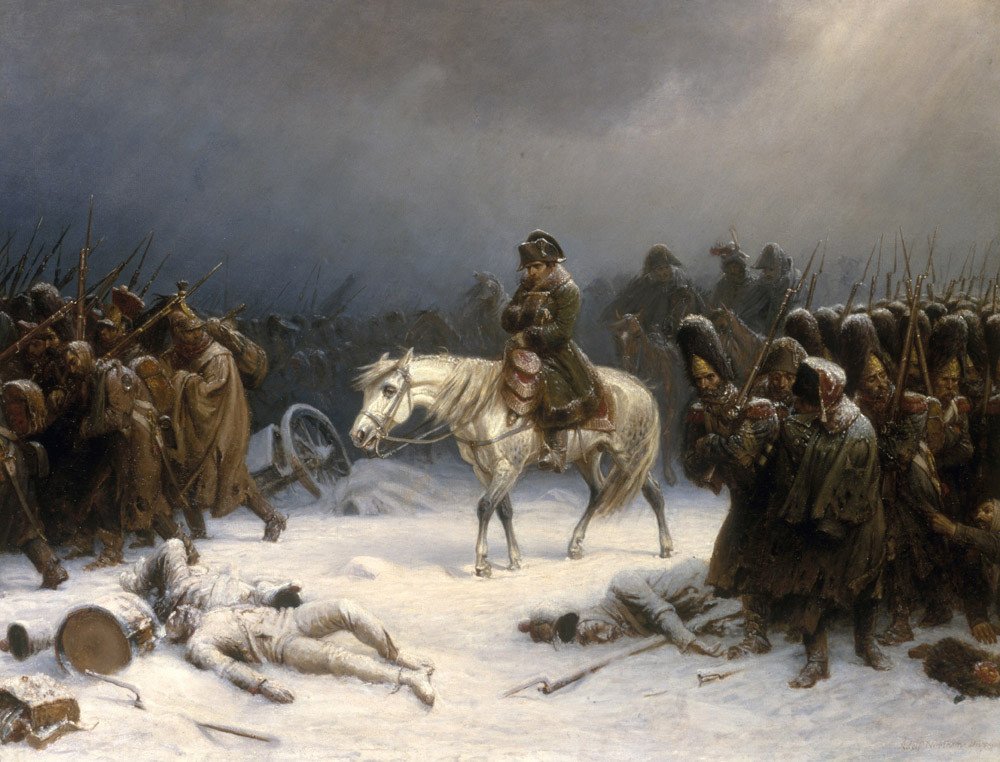
After abandoning Moscow in October, Napoleon was determined to move what was left of his army to its supply base at Smolensk, nearly 270 miles to the west. The Russians, aided by their old ally, General Winter, harassed the French the entire way. So depleted were Napoleon's forces by the time they reached their objective that Bonaparte decided he could no longer hold the position. He hoped to reach Orsha, a supply base further west, then planned on making winter camp near his huge depot at Minsk.

Assuming his enemy was just as hampered by the weather as his own troops, Napoleon decided to move his men out as quickly as possible. Instead of concentrating his army, he sent it out piece-meal, corps by corps on the road to Orsha. Napoleon himself, personally commanding a unit of veterans known as the Imperial Guard, planned to wait for the rear units of the army at a small town called Krasnoi, now known as Krasny near the modern day border with Belarus. It was here, with the battered Grand Armee staggering into town piece by piece, that the Russians struck on November 17, 1812.

The battle itself is not overly significant, with the Russians lashing at the heels of a battered enemy that, while unable to offer much resistance, was retiring in good order. A strong feint by the Imperial Guard gave most of the army enough time to move through the city and continue toward Orsha. The approach of the Russian army, however, meant that French units could not wait for their rear guard to catch up as originally planned. Any remaining men in the tail end of Napoleon's army would be forced to fight their way through enemy lines to rejoin their comrades.

Luckily, the rear guard was commanded by Michel Ney, Napoleon's close friend and one of his original Marshals of the Empire. As is our practice here at Lies Agreed Upon, we must take a moment to recognize Ney, our honorary over-zealous Frenchman of the day. Serving since 1787, Ney was the extremely seasoned leader of the army's III Corps, and earned the dubious honor of commanding the rear guard.


Marshal of France
Michel Ney
.


Ney had fought under Napoleon since the Emperor's first days in command and continuously proved his worth. Affectionately dubbed Le Rougeaud, or Red Face, by his men, not even a neck wound suffered a few months before the retreat was enough to keep him from duty. Arriving at Krasnoi late on November 17, Ney was surprised to find the Russians, not his comrades, waiting for him. Undeterred, and convinced the remnants of the Grand Armee were nearby, Ney ordered his exhausted Corps to attack the next morning.

They nearly succeeded. Three lines of Russian infantry lay before him, and Ney's veterans slashed, shot and gouged their way through the first two. The third line, however, refused to yield, and a swift counterattack nearly routed what was left of III Corps. Ney, cut off from his commander and left with only a few thousand men, fled into the forest. For the next few days they blindly marched to the west, constantly shadowed by the dreaded Russian Cossacks. Ney eventually reunited with Napoleon near Orsha on November 20, a feat so impressive even the egotistical Bonaparte dubbed him Le Brave des Braves, "The Bravest of the Brave."

Ney cemented himself a place in military history for his relentless drive toward Krasnoi. Twice during the battle, first when he came in sight of the Russian lines and then again after the counterattack scattered his forces, the enemy offered Ney a chance to honorably surrender. Both times, he refused. He served under Napoleon all the way to Waterloo three years later, a battle that saw five horses shot from under him.

After Napoleon was exiled Ney was arrested and tried for treason. Despite a huge public outcry for one of France's heroes, he was convicted and sentenced to death, perhaps to set an example for Bonaparte's other followers. Before the firing squad, he refused the customary blindfold and gave the order to fire himself, with these stirring final words:
Soldiers, when I give the command to fire, fire straight at my heart. Wait for the order. It will be my last to you. I protest against my condemnation. I have fought a hundred battles for France, and none against her. Soldiers...Fire!
It sounds like Napoleon knew bravery when he saw it.

Wednesday, June 24, 2009

June 24, 1812

A Note on General Winter: Or How We Cover Napoleon, Sun Tzu, and Hitler in a Single Bound.


Although we covered an invasion of Russia just two days ago (and quite a similar one at that), this gives us a chance to look at the comparable invasions of Adolph Hitler and Napoleon Bonaparte. Plus, we will never pass up a chance to give the Little Dictator some press. He did name this blog, after all.


At the height of the Napoleonic Wars, Bonaparte had a strong hold on most of continental Europe. The defeat at Trafalgar in 1805 proved he lacked the naval power to invade the the British isles, but he beat back a Russo-Austrian invasion in the East a few years later. Just as Hitler would over a century later, Napoleon sought to destroy his biggest enemy on the mainland. On June 24, 1812, his Grand Armee, 690,000 strong and composed in large part of foreign conscripts, crossed the Nieman River and set off to Moscow. When they returned six months later, they numbered just 22,000.


Both the 1812 (Patriotic War if you're a Tsarist) and 1941 (Great Patriotic War if you're a Soviet) invasions failed, stymied by the size of Russia's territory and the sacrifices of her sons. For five more quick reasons why, we can go to our old friend Sun Tzu, whose Art of War never fails to prove itself as the authority on warfare.

Sun Tzu wrote "the art of war is governed by five constant factors":


(1) The Moral Law
(2) Heaven
(3) Earth
(4) The Commander
(5 )Method and Discipline


For fun, lets see how Dolph and Nap match up against ol' Mother Russia.

(1) The Moral Law- Sun Tzu describes this as identifying with which side the morality lies. Which side, if any, has a more just cause for fighting. Defending themselves from invasions attempting to wipe them off the map, in both cases surely the first point goes to the Russians.
(2) Heaven (And we don't mean God)- When Sun Tzu wrote "Heaven" he meant time, weather and seasons, not Jesus, Allah and the Flying Spaghetti Monster. Notice these invasions were launched just two days apart on the calender. At least Hitler and Napoleon were mindful of this, jumping off at the start of summer. But costly battles and logistical nightmares kept them from prevailing before Russia was saved by her greatest ally: General Winter. Russia up 2-0-0.
(3) Earth- Location, Location, Location. By earth, Sun Tzu meant the very land on which the battles are fought. Russia is impossibly large, and any plans to invade it are impossibly ambitious. Two armies, both at the time of invasion the largest in the world to that point, failed to conquer all that territory. Furthermore, had they succeeded, maintaining a presence in that area for any period of time would be a more than herculean effort. Russia still pitching a shutout as we go to the top of the fourth.
(4) The Commander- This one speaks for itself. There is definitely something to be said for conquering most of Europe, as both Hitler and Napoleon did. However, they both suffered from, among other things, over-ambition, the same strategic flaw. And if a commander is supposed to extend some of his own virtues into his army, surely the virtues of these two men were not desirable ones to inherit. Hitler loses the point for his martial ignorance. Napoleon was a much better military mind, but if you're a commander and you decide to invade Russia, you lose this point automatically. 4-0-0.
(5) Method and Discipline- Napoleon himself said an army marches on its stomach, and Sun Tzu's methods and disciplines revolved mostly around logistics and supply. As mentioned, maintaining armies across the vast Russian steppe, even in high summer, is a daunting task. Combined with these first four points, even in mildest winter an invasion of Russia is just a no-win.

So, it was worth looking at the 1812 invasion of Russia, even if we just did Barbarossa. The similarities between the two campaigns are remarkable, then add in the lofty personalities involved and this is too good to ignore. Plus, 6th Century BC Sun Tzu still relates to military history in the 19th and 20th Centuries. Any time we get Sun Tzu in here, we've done our job.